


Global AI Digital Cartel Disguised as an Ecosystem
We’re witnessing the rise of a global digital cartel — a closed circuit where the same players exchange billions among themselves and call it “innovation.” Nvidia invests in OpenAI, which pays Oracle, which buys Nvidia’s chips.
Analysis of Bloomberg’s “The Complex Web of AI Deals”
1. General Context
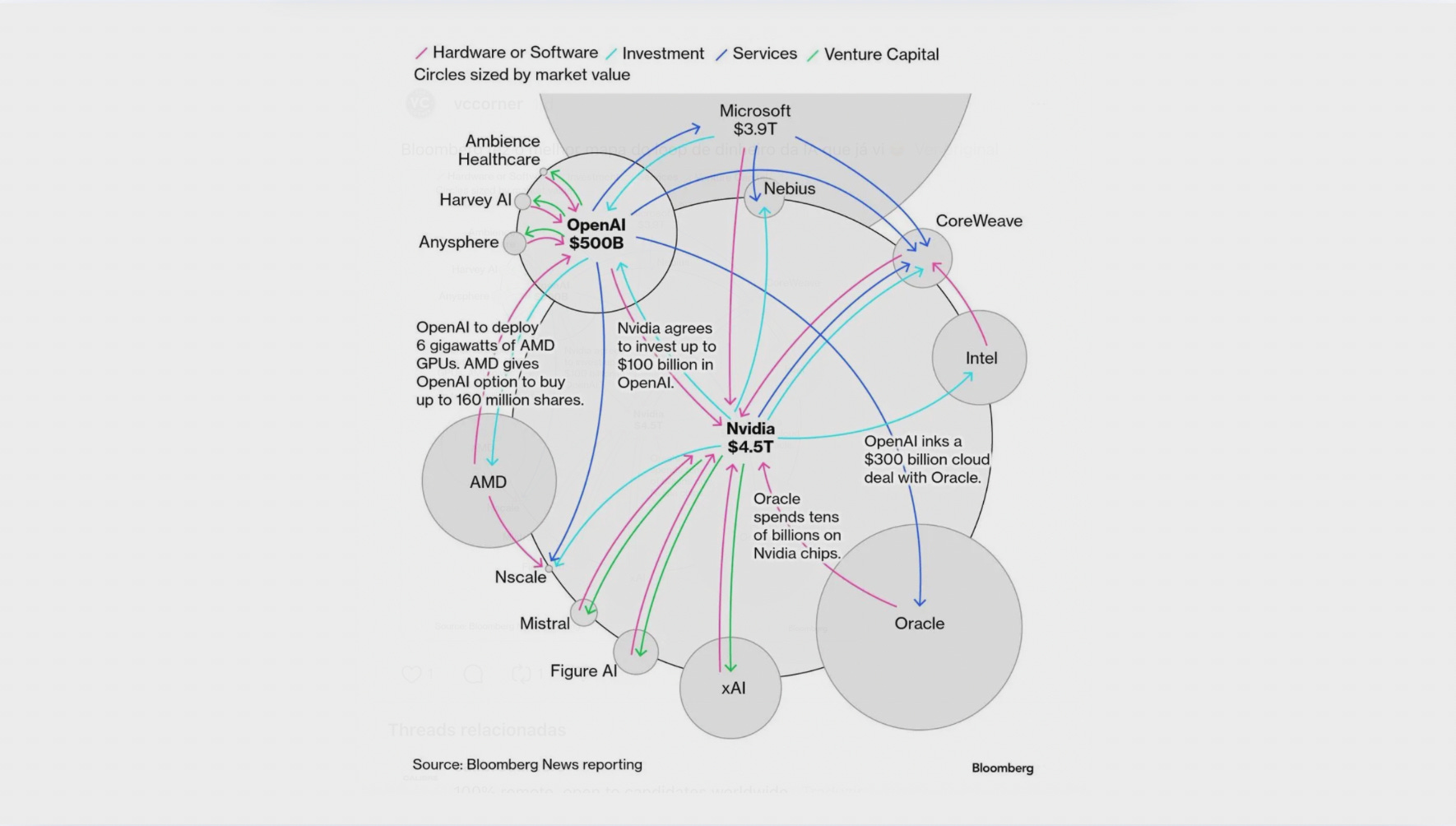
The map reveals an almost circular web of interdependence among tech giants , Nvidia, OpenAI, Oracle, AMD, Intel, and CoreWeave , that currently dominate the AI ecosystem.
These relationships blend cross-investments, cloud contracts, chip supply, and equity stakes in a self-reinforcing system.
The practical effect: the same money keeps circulating in a loop among a handful of companies, amplifying their power and creating an almost impenetrable barrier for newcomers.
2. Main Financial Relations
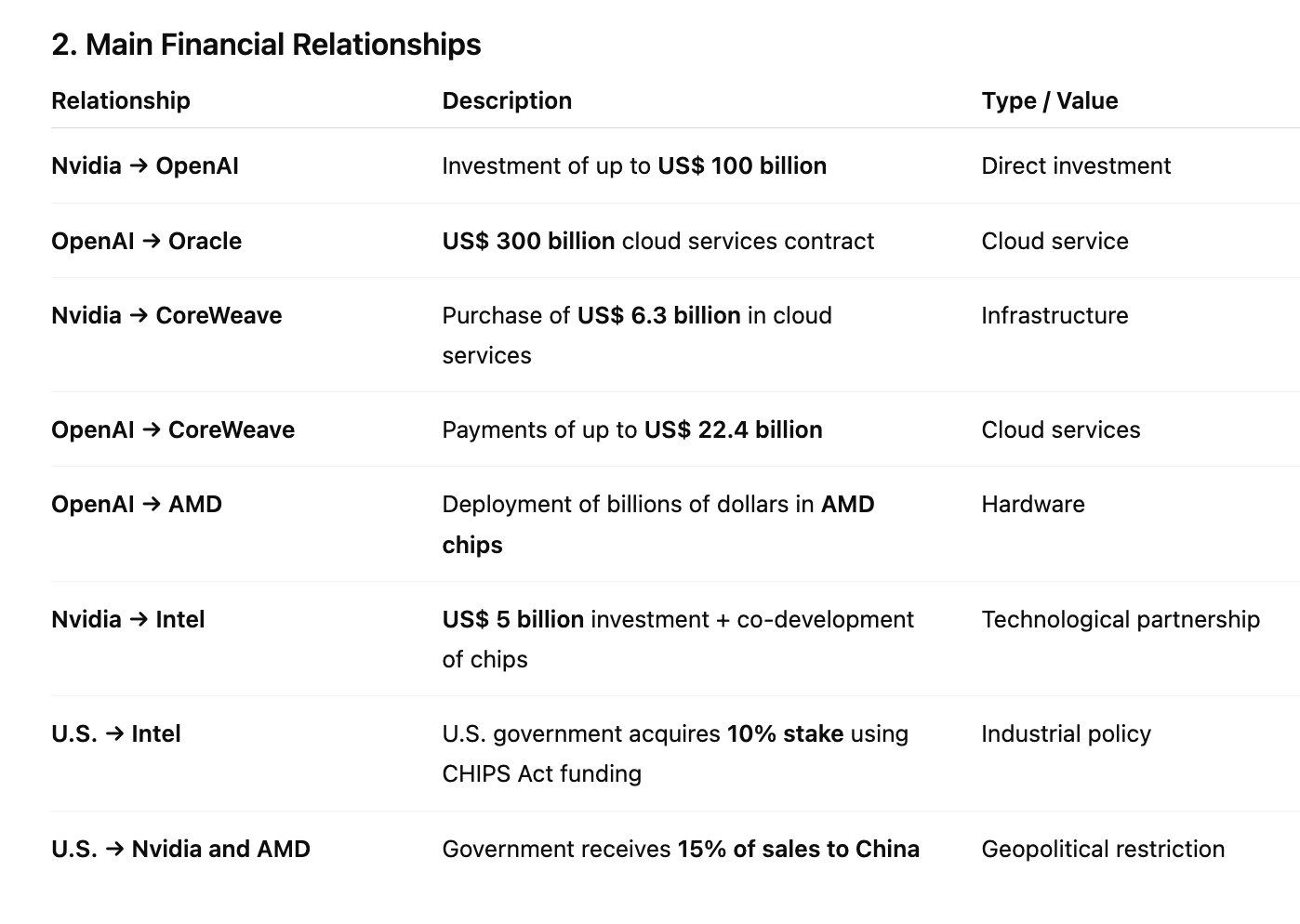
These values show multi-billion-dollar transfers moving in every direction — but always among the same actors. It’s as if an AI oligopoly were consolidating its borders and no outsiders were being invited in.
3. Strategic Reading of the Flow Map
The second Bloomberg chart visualizes this network:
Nvidia ($4.5T market cap) is the central node — it supplies chips to almost everyone, yet also invests in and buys services from the very companies it powers.
OpenAI ($500B) acts as the demand hub, spending fortunes with Oracle, AMD, and CoreWeave to sustain its models, while receiving massive injections from Nvidia.
Oracle is the cloud bank of the system: it hosts OpenAI’s infrastructure and simultaneously buys Nvidia chips, reinjecting capital into the loop.
AMD and Intel appear as secondary suppliers, fighting for space in an environment dominated by Nvidia and partially funded by the U.S. government.
CoreWeave and Nebius represent the new chain link — elastic-compute providers created to absorb OpenAI’s traffic, yet still dependent on Nvidia’s infrastructure.
The diagram shows how every dollar of investment triggers a chain reaction, returning to its origin through other channels (chip contracts, cloud services, equity, or state subsidies).
4. What the Data Reveal
AI has become a closed system — the companies that build the hardware, software, and cloud also finance one another.
Systemic risk has grown: if one collapses (say Nvidia or OpenAI), the domino effect would hit all others.
The U.S. government appears as a control actor, trying to keep the supply chain under U.S. jurisdiction through the CHIPS Act and export restrictions to China.
The level of concentration is unprecedented: seven companies control the technical and financial core of global AI.
5. Provocative Readings
What we’re seeing is a digital cartel disguised as an innovation ecosystem.
The investment cycle is autophagic: money flows from Nvidia to OpenAI to Oracle — and back to Nvidia through chip sales.
The so-called “AI race” isn’t competition; it’s oligopolistic cooperation regulated by billion-dollar contracts and public subsidies.
This circuit might be inflating a speculative bubble — valuations built on circular demand expectations rather than real profit.
Summary in One Sentence
Bloomberg’s map reveals that the AI empire operates like a closed energy market, where the same players trade resources among themselves — creating a self-referential, power-concentrated ecosystem.
Direct and Structural Impacts
Financial: extreme capital concentration and a new form of technological “shadow banking.”
Technological: systemic-collapse risk if one link (Oracle or Nvidia) fails.
Geopolitical: global dependence on U.S. infrastructure.
Social: widening asymmetries — countries and firms outside the loop remain dependent on foreign clouds and chips.
Narrative: the “AI race” stops being a metaphor for innovation and becomes a choreography of power.
Signals to Watch (Strategic Observation Radar)
CHIPS Act 2.0 moves — new U.S. semiconductor subsidies signal power consolidation.
CoreWeave expansion — if it launches an IPO or lands new OpenAI contracts, the loop accelerates.
Nvidia–Microsoft relations — a new investment round would mark a strategic bid for total infrastructure control.
Oracle–OpenAI contract changes — any renegotiation may signal financial stress.
Geopolitical blockades — further U.S. chip-export sanctions to China will be the true risk thermometer.
Entry of sovereign funds (Saudi, India, or EU) — direct investment in Nvidia or OpenAI would shift the geopolitical balance of AI.
Questions for Readers
If all AI money circulates among the same companies, can we still call it “innovation” — or is it a programmed collapse disguised as progress?
Do you really believe this race is competitive — or a well-choreographed oligopoly capturing the future of computation?
What happens when the next bottleneck isn’t chips but electric power and private data?
If OpenAI, Nvidia, and Oracle collapsed simultaneously, who could keep the global AI system running?
Are governments actually regulating — or funding the very concentration they pretend to fight?
Are we entering the era of circular AI, where money spins among a few while the rest of the world foots the bill?
And what if the opposite is also true — that this interdependence is the only thing preventing a global digital-infrastructure crisis?
Want to stay ahead of the curve?
Subscribe to Tech Gossip:
#AIcartel #NvidiaEmpire #OpenAIloop #AIbubble #TechOligopoly #DigitalColonialism #AIgeopolitics #CloudWars #SiliconSyndicate #FutureControl #DataPower #ArtificialEmpires #SystemicRisk #TechTruth #RadarOfTheEndOfTheWorld